
Hi-Lo Casino UK: How the Card Shoe Shapes Each Round
 Available in GB
Content
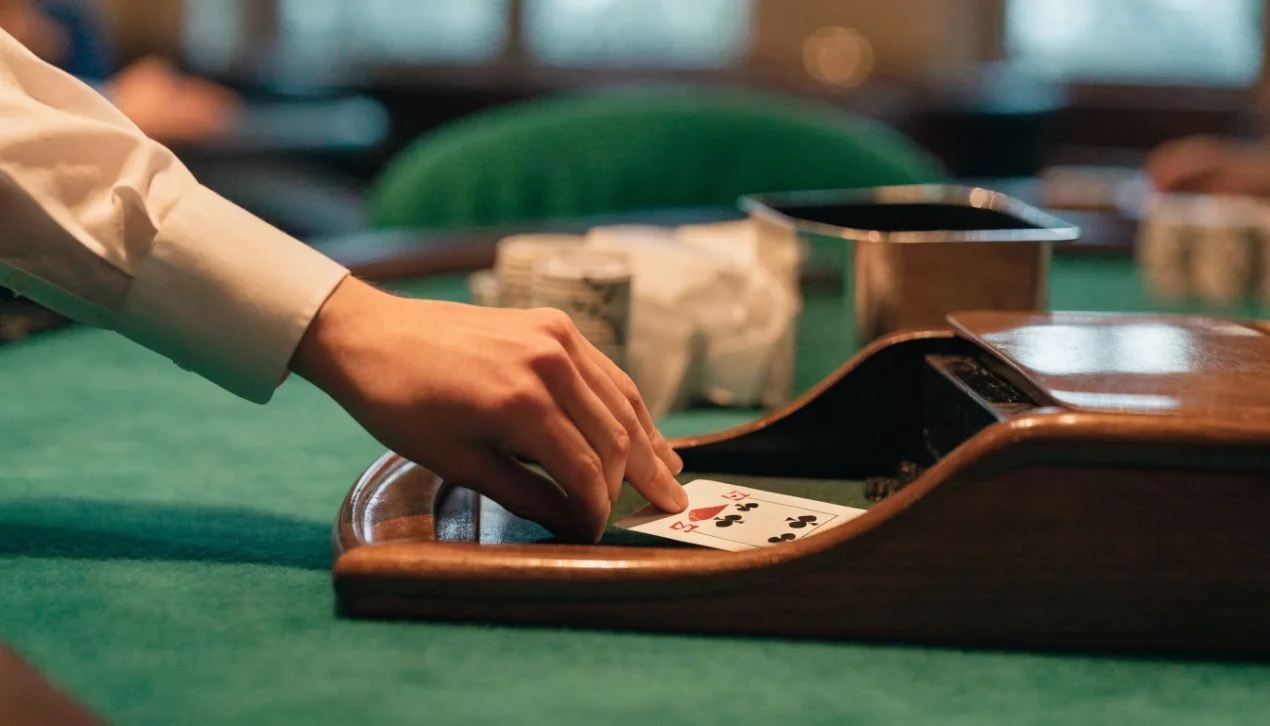
The reference card carries forward, while the next result is revealed only after three unseen cards are burned.
How the Live Card Shoe Determines the Next Hi-Lo Result
In a live card-shoe Hi-Lo game, the next result depends on a sequence of physical cards, not simply on the card shown on screen. The visible card from the previous hand becomes the reference card for the next round. Before the next winning card is revealed, three cards are burned: removed from the sequence without being used as the result. The card that follows those burns determines the new outcome.
That order matters. The reference card is known, but it does not tell you which card will appear after the burns. Nor do the three unseen cards establish what the winning card must be. They are part of the draw process, while only the card revealed after them supplies the next result. The game therefore presents a clear chain of events, but not a predictable one.
The reference card carries over
The previous hand’s winning card remains exposed and serves as the reference for the next round. This gives each new decision a visible starting point: the next result is assessed in relation to that card, rather than to a fresh, unrelated starting value.
That carry-over can make consecutive rounds look linked. They are linked in one specific way: the last winning card sets the reference for the next round. It does not mean the card is removed from the shoe permanently or that the next card can be inferred from it. In this format, cards used in the previous round are returned to the continuous shuffler, so the visible reference card is not evidence that the same card has been taken out of circulation.
JetX Casino Game in the UK: Slot or Crash Game?
The distinction between a reference card and a card’s physical availability is easy to miss. The reference card remains relevant to interpreting the next result, while the shuffler’s process governs which card is drawn. Those are separate parts of the game: one establishes the comparison point; the other supplies the card that decides the hand.
What the burn cards do
Three cards are burned before the next winning card is revealed. A burn card is not the result displayed for the hand. It is passed over in the sequence, so the fourth card in that run is the one that becomes the next winning card.
For the viewer, the important point is that the revealed result is not simply the first card drawn after the reference card. The intervening burns are part of the stated procedure. They do not provide a visible preview of the winning card, and the fact that three cards are passed over does not by itself indicate whether the eventual card will be higher or lower.
This is why a live shoe should be understood as a process rather than as a simple two-card comparison. There is an exposed reference card, a set of unseen cards that are burned, and then the card that determines the new result. Following that sequence helps explain what the display is showing without treating the hidden cards as clues.
Continuous shuffling changes the card flow
A continuous shuffler is used, and cards from the previous round are returned to it immediately. The shoe is therefore not described as a fixed run in which every card dealt remains out until a later reshuffle. Instead, used cards go back into the shuffling process as play continues.
Because cards from the previous round are immediately returned to the continuous shuffler, a card shown in a previous hand may re-enter the game.
That has a practical consequence for understanding the next draw: the visible history of earlier rounds is not a complete record of cards that have been permanently removed. A card shown in a previous hand may re-enter the shuffler, so the fact that it appeared earlier does not, on its own, rule out its return. The mechanism combines a carried-over reference card with a changing supply of cards in the shuffler.
A specialist review describes the setup as six decks of 48 cards, with the tens removed. The reported arrangement should therefore not be treated as a settled description of every live game, or as a guarantee that every table uses the same shoe.
This uncertainty matters because deck composition affects what a player might assume about the cards available.
When watching live casino Hi-Lo, focus on those steps in order. The reference card tells you what the next result is measured against. The burn procedure explains why the displayed result is not the first card drawn. The continuous shuffler explains why earlier cards are returned to circulation rather than simply disappearing from the game. None of these details makes the next card certain; together, they describe how the game produces it.
What “Best” Means When Comparing Hi-Lo Casino Games
If you’re choosing a UK hi-lo casino in 2026, payout timing is one practical detail to check. This list gives you the stated withdrawal speed for each operator.
1. NightLuck
Payout speed: 1-3 business days
NightLuck lists a payout speed of 1–3 business days, giving you a stated timeframe to consider.
2. BeOnBet
Payout speed: 1-3 business days
BeOnBet lists a payout speed of 1–3 business days, giving you a stated timeframe to consider.
3. Britsino
Payout speed: 1-3 business days
Britsino lists a payout speed of 1–3 business days, giving you a stated timeframe to consider.
4. Zombillion
Payout speed: 1-3 business days
Zombillion lists a payout speed of 1–3 business days, giving you a stated timeframe to consider.
5. Revery Play
Payout speed: 1-3 business days
Revery Play lists a payout speed of 1–3 business days, giving you a stated timeframe to consider.
6. Dieselwin
Payout speed: 1-3 business days
Dieselwin lists a payout speed of 1–3 business days, giving you a stated timeframe to consider.
7. NightWin
Payout speed: 1-3 business days
NightWin lists a payout speed of 1–3 business days, giving you a stated timeframe to consider.
8. Chanze
Payout speed: 1-3 business days
Chanze lists a payout speed of 1–3 business days, giving you a stated timeframe to consider.
9. x3bet
Payout speed: 1-3 business days
x3bet lists a payout speed of 1–3 business days, giving you a stated timeframe to consider.
10. EvoSpin
Payout speed: 1-3 business days
EvoSpin lists a payout speed of 1–3 business days, giving you a stated timeframe to consider.
A higher stated return can make a Hi-Lo game look more attractive, but the figure is only useful if you know what it describes. The available estimates attach different returns to different choices or approaches. They are not a ranking of casinos, and they do not establish that every version of Hi-Lo offers the same result.
One specialist review reports a return of 96.23% for bets on higher than 4 or lower than 10. That figure is tied to those particular betting choices; it should not be read as the return for every bet in the game, or as a promise about what you will receive in a session. The same review gives 96.07% when following basic strategy. The gap between those two reported figures is small, and both are estimates associated with specified play rather than a guarantee for an individual player.
A separate specialist analysis reports a 100.36% return when using a card-counting strategy. That number is notably different from the other estimates, but it should not be treated as a standard return available to every player. It is expressly linked to a particular strategy, and the figure alone does not tell you whether the game you are considering uses the same assumptions. A percentage above 100% can sound decisive; without the underlying conditions, it is not a reliable basis for choosing a site or game.
Video Slots in the UK: Reels, Paylines and Play
These estimates cannot be combined into a single dependable league table. The basic-strategy figure, the figure tied to specified higher-or-lower bets and the card-counting figure describe different approaches. Comparing them as if they were competing versions of the same offer would obscure that distinction. A stated return is meaningful only alongside the rules and assumptions used to calculate it.
Read the choice behind the return
If a game displays a return figure, look for the play pattern it refers to. Is it based on a particular bet, a stated strategy, or a broader calculation? The reported 96.23% figure is associated with betting higher than 4 or lower than 10, while 96.07% is associated with basic strategy. Those are not interchangeable descriptions. If the explanation does not make the connection clear, the percentage tells you less than it may appear to.
The card-counting estimate needs the same scrutiny. Its reported 100.36% is tied to card counting, not simply to selecting a Hi-Lo game. It does not show that a player will achieve that result, nor does it make the other estimates irrelevant. Treat it as a conditional figure, rather than as a general property of Hi-Lo or evidence that one casino is better than another.
A return percentage is a theoretical measure, not a forecast of your next outcome. It does not mean that a particular session will return that proportion of your stake, and it cannot remove the possibility of losing. The distinction matters especially when figures are close: a narrow difference between two estimates does not automatically translate into a noticeable advantage for an individual player.
A return percentage is a theoretical measure, not a forecast of your next outcome, and cannot remove the possibility of losing.
Compare like with like
When assessing what might be called the best Hi-Lo casino game, separate the game’s reported return from the site hosting it. The figures above do not identify or rank operators, and they do not verify that a particular site offers the game or the stated conditions. A casino’s name cannot make an estimate more certain.
Instead, check whether the return is attached to the same kind of game and the same decision rules you would actually encounter. Confirm what the stated percentage assumes, which betting choice it concerns and whether a strategy is required. If those details are not supplied, avoid treating the percentage as a direct comparison with a better-explained figure elsewhere.
The practical takeaway is not that one number settles the choice. The highest reported estimate here is 100.36%, but it belongs to a card-counting approach; the other reported estimates are 96.23% for specified higher-or-lower bets and 96.07% for basic strategy. Each needs to be read with its stated context. A clear explanation of the figure is more useful than a headline percentage without its conditions.
Live Hi-Lo Sites: Check the Game Format Before You Play
“Live” does not tell you exactly how a Hi-Lo game works. The term may bring to mind a card table, but a specialist review describes a different format built around a reel. In that version, you choose whether the reel’s result will be higher or lower, then the number where it stops determines the outcome. That is not the same process as predicting a card from a live shoe.
Highest RTP Slots in the UK: What the Figures Mean
The distinction matters before you place a bet. A live card-shoe game uses a card as its reference point; the reel-style version described here uses the number shown by the reel. If a page says “live Hi-Lo” but does not make clear which format it offers, look at the game’s own instructions or demonstration rather than assuming that the label settles the question. Not every live casino site offers a reel-style Hi-Lo game.
What the reel result means
In the described format, you select one reel and choose a direction. A result in the direction you picked counts as a win. A result in the opposite direction is a loss, and a tie also loses. So a tie is not a neutral outcome in this version.
That detail is worth checking in the rules before you play. A title or short description may make the game sound like a simple higher-or-lower choice, but the settlement rule determines what happens to your stake. In particular, do not assume that a matching result will return your bet just because some card games treat a tie as a push. The stated reel rules make ties losses.
The central question is therefore not only whether the number moves up or down. You also need to know how the game defines the direction of a result and how it treats a tie. Read the displayed instructions for the specific game you have opened: a description of one reel-style version is not proof that another title follows the same rules.
What happens after a win
The specialist review’s account says that, after a win, you may either parlay the original bet and its winnings or collect and start again. “Parlay” here means leaving the amount at risk for another round, rather than taking the winnings out of play. Collecting ends that run and lets you begin afresh.
Post-Win Options
After a win, you may either parlay the original bet and its winnings by leaving the amount at risk for another round, or collect the winnings and start again.
Those choices affect how a session proceeds, but they do not change the basic result of the reel: it either lands in your chosen direction, in the opposite direction, or on a tie. Before continuing after a win, check whether the game is asking you to risk the accumulated amount or allowing you to collect it. A wrong guess can void all winnings collected in that game, so an earlier win should not be treated as money already secured while you continue.
The reported choice to parlay or collect belongs to the described version, not to every live Hi-Lo game. Check the rules shown for the particular title rather than carrying that feature across to a different format.
Do not confuse a reel with a card shoe
A live card-shoe game and a reel-style game can share the higher-or-lower idea while producing results differently. In the shoe version, a card is the reference for the next prediction. In the reel version described here, the reel’s stopping number is compared with the direction you chose. The word “live” alone does not tell you which mechanism is in use.
That difference also means the same shorthand can hide different settlement rules. A card game may explain what happens when the next card matches the reference card; the reel description above instead says a tie loses. Treat the instructions as specific to the game in front of you, not as universal Hi-Lo rules.
For a live Hi-Lo online casino, the practical check is simple: establish whether the result comes from a card or a reel, then read how a win, an opposite result and a tie are settled. That gives you a clearer picture of what you are betting on than the word “live” does on its own.
Chicken Road Casino UK: Game Type and What to Check
The Core Hi-Lo Bet: Higher or Lower Than the Current Card
At the centre of the described online Hi-Lo game is a comparison between two cards. You see a current card, then choose whether the next card revealed will have a higher or lower value. The choice is about rank, not suit: the game assigns values from ace at one point through to king at 13 points.
That gives each guess a clear reference. If the current card is a six, for instance, a higher guess predicts a value above six; a lower guess predicts one below it. The next card decides whether that prediction was right. It is not enough to guess that a card will be different: the direction matters.
The ace-to-king scale is worth keeping in mind because card names do not all make the comparison feel equally obvious. An ace is at the low end of the stated values, while a king is at the high end. For cards between those points, you compare the value of the current card with the value of the one revealed next. The central rule remains the same whichever card is showing: predict higher or lower.
A correct guess adds winnings to your pot. The pot is the running amount associated with the game, so a successful call increases what is held there. An incorrect guess has the opposite result: the money placed on that call is lost. The distinction matters. A wrong prediction is not simply a missed chance to add to the pot; it costs the amount committed to that guess.
Loss of Winnings
If you guess incorrectly, all winnings accumulated in that game are void.
There is also an important consequence for anything already won in the same game. If you guess incorrectly, all winnings accumulated in that game are void. So the potential gain from a correct prediction comes with the risk that a later mistake removes the winnings collected along the way. A growing pot should not be mistaken for money already secured.
This is the basic higher-or-lower mechanic, not a promise that every game labelled Hi-Lo uses identical rules. The description applies to this online version. Other formats can make the result depend on something else, such as a reel, or use different rules for how cards are dealt. The name alone does not tell you which mechanic is in front of you.
Before making a call, identify the current card and compare its value with the two possible directions. Your selection is a prediction about the next revealed card, not a choice between two guaranteed outcomes. The next card can confirm the call or make it wrong, and the pot changes accordingly. That simple sequence—current card, directional guess, next reveal, result—is the core of the bet.
Draw Hi-Lo: A Single Deck and a Choice to Stop
Draw Hi-Lo uses one standard deck of 52 cards. Aces are always low, and cards that have already appeared are not put back. That means a card used earlier in the same game cannot be drawn again. The deck’s composition therefore changes as play continues: each revealed card is gone from the remaining pool.
This is different from a game in which cards are continually returned to a shuffler. In Draw Hi-Lo, the sequence of cards matters because the deck is not replenished during the game. It also means that a fresh game begins with a full deck, while a game already in progress does not. The distinction is about the rules of this version, not a promise that every online casino offering Hi-Lo uses the same format.
Plinko casino UK: licensing, offers and payments
The central feature for a player is the option to stop. After making the first decision, you can leave the game at any point and collect the winnings accumulated so far. You do not have to continue making guesses until the deck is exhausted. Continuing keeps the game going; stopping ends your participation and secures the amount available to collect at that stage.
That choice makes it important to distinguish between winnings already accumulated and a possible future win. Continuing gives you another chance to add to the total, but it also exposes the game’s existing progress to the next result. If a guess is wrong, all winnings collected in that game are void. The ability to stop is therefore meaningful: it lets you end the round rather than risk the accumulated winnings on another decision.
The single-deck rule gives this version a definite boundary. No card can recur within the same game, and cards that have been drawn do not return to the supply. A player can continue only while the game permits another decision; the stop option remains available after the opening choice. Once you collect and leave, that game is over, rather than a pause with the same run waiting to resume.
Before playing, check that the screen actually describes Draw Hi-Lo and its stop-and-collect feature. The name alone does not establish that a particular casino’s game follows these rules. Some Hi-Lo formats use different card arrangements or mechanics, so it is the displayed rules—not the broad label—that tell you whether cards are removed after use and when you can collect.
Draw Hi-Lo Basics
- Uses a single standard deck of 52 cards where aces are always low.
- Cards already drawn are not put back, changing the deck composition.
- You have the option to stop and collect accumulated winnings at any point after the first decision.
- An incorrect guess voids all winnings collected in that game.
In practical terms, Draw Hi-Lo combines a fixed deck with control over when to end your run. The deck does not reset between decisions, and the option to stop does not remove the risk of continuing. It simply gives you a point at which you can take the accumulated winnings instead of making another guess.
Check Who Licences a Hi-Lo Casino Site in Great Britain
Before depositing, establish which business operates the casino and whether it holds the required UK Gambling Commission licence. The Commission regulates commercial gambling in Great Britain, including remote gambling offered to consumers there. Its remit does not depend on where a site’s servers or other key equipment are located.
That matters when a casino presents itself as based overseas. A foreign address or equipment location does not, by itself, remove the requirement for a business offering remote gambling to people in Great Britain to hold the relevant Commission licence. The UK Gambling Commission is Great Britain’s sole regulator for commercial gambling.
What the licences cover
The Commission issues operating licences to businesses and personal licences to individuals working in relevant roles. These are different forms of authorisation: an individual’s licence is not a substitute for the operating licence required by the business offering the gambling.
A site may display a licence claim in its footer or terms, but that claim should be checked against the Commission’s public register. Find the operator’s licence number on the site, then search for it in the register before paying in. Confirm that the register entry identifies the business behind the site and that the licence is current. If the number cannot be found, or the registered business does not appear to match the operator named on the site, do not treat the claim as confirmation of authorisation.
Online Bingo in the UK: Tickets and Game Formats
The distinction between a casino brand and its operating company can make this check less straightforward. A familiar site name may not be the legal name recorded by the regulator. Look for the company details associated with the licence, rather than relying on branding or a badge displayed on a page. If the site does not make clear which business is responsible for it, that is a reason to pause rather than guess.
Check the register, not just the claim
A licence number is useful only when it can be matched to an entry on the UK Gambling Commission’s register. A logo or a statement that a site is “regulated” is not the same as verification. Check the regulator’s record directly, and make sure the business offering the Hi-Lo game is the one covered by the relevant operating licence.
This check concerns the operator’s standing, not the game’s rules or advertised return. A game description cannot establish that the business behind it is authorised. Nor does a licence held by a different company prove that the site you are using is covered.
If you cannot establish a clear match between the site and a current operating licence, do not deposit until you can. The register gives you a way to check who is accountable for offering the gambling in Great Britain, rather than relying on what the site says about itself.
Licence Verification
- Find the operator’s licence number on the site.
- Search for the licence number in the UK Gambling Commission’s public register.
- Confirm the register entry identifies the correct business behind the site.
- Verify that the operating licence is current.
Hi-Lo Game Versions Do Not All Use the Same Deck Rules
A Hi-Lo game can treat a card that has already appeared in very different ways. In the single-deck version, the pack contains 52 cards, and a card is not put back after it has been used. The deck therefore becomes smaller as play continues, and a card already seen cannot appear again in that game.
The live version is described differently: cards from the previous round go straight back into a continuous shuffler. That means the next round is not dealt from a pack that simply keeps shrinking as cards are played. The used cards rejoin the supply being shuffled, rather than remaining out of circulation for the rest of the game.
There is also a direct disagreement over how the live shoe is set up. One specialist review describes six decks of 48 cards, with tens removed, alongside continuous shuffling. The single-deck account, by contrast, specifies a 52-card deck with no replacement of used cards. These are not two descriptions of the same card supply: one returns cards to a shuffler between rounds, while the other keeps used cards out.
That distinction matters when you interpret what a past card tells you about future availability. In a no-replacement deck, seeing a card means that particular card cannot recur in the same game. In a continuous-shuffling format, previous-round cards are returned, so a card seen earlier is not necessarily absent from the next round’s supply. The history of exposed cards therefore has a different bearing on what remains available.
High-Volatility Slots in the UK: How They Work
The label “Hi-Lo” alone does not tell you which arrangement applies. Check the rules for the specific game, particularly whether used cards are returned and whether the description refers to one deck or a continuously shuffled shoe. Do not assume that every online version follows the single-deck rules, or that every live game uses an identical deck count. The stated formats differ, and treating them as interchangeable can give you the wrong picture of how card availability changes during play.
A Practical Hi-Lo Strategy: Compare the Payout and the Cards Left
For a Higher or Lower bet, compare the two displayed payouts before choosing. The recommended approach is to select the option that pays more. That is a way to use the information shown at the table, not a promise that the higher-paying choice is more likely to win. A larger payout and a greater chance of success are different things.
Check the rules for the bet as well as its payout. In this version, a Higher or Lower wager loses if the next card matches the current card. A choice that appears to cover many possible values therefore does not remove the risk of a tie. Read the game’s pay table carefully so you know what each outcome means for your stake.
Proposition bets need a different check: consider which cards are still available. A proposition bet is a wager on a particular outcome or condition, rather than simply whether the next card is higher or lower. In the live shoe game, the winning card from the previous hand remains exposed as the reference card, but it has already been removed from the shoe. Do not count it as a possible card that could produce a win on your proposition bet.
Strategy Tip
When placing proposition bets, base your decision only on cards that can still be dealt, excluding the visible reference card.
That matters because an outcome can look plausible when you judge it against the full set of card values, yet one of the cards that would satisfy it may no longer be available. Base the decision on cards that can still be dealt, not on the visible reference card as if it could appear again.
No choice removes the game’s underlying uncertainty. A correct guess may add winnings to your pot, but a wrong guess voids all winnings collected in that game. Treat the payout comparison and the card check as ways to understand the wager, not as a method for securing a result. If the terms of a proposition bet are unclear, avoid placing it until you can establish exactly which remaining cards count as winning outcomes.
Before Depositing at a Hi-Lo Casino Site
Before putting money into a Hi-Lo account, check what the site asks you to do at registration and what controls remain available afterwards. In Great Britain, an operator must verify your age before it allows you to deposit. This is not a check to leave until you try to withdraw: the deposit gate comes first.
New customers must also be prompted to set a financial limit before making their first deposit. The point is to decide in advance how much money you are prepared to put into the account, rather than making that decision while playing. The operator must make account-level limit controls accessible, so you can manage the limit from your account rather than relying on a one-off prompt. Look for those controls before you deposit and understand where to find them again.
Payment rules matter too. UK-licensed casinos cannot accept credit cards for gambling. If a payment option appears to involve credit-card funding, do not assume that its presence means it can be used for a gambling deposit. The restriction applies to gambling payments, not merely to a particular card brand.
RTP Casino Slots in the UK: How Returns Work
A licensed operator must provide responsible-gambling tools, including self-exclusion. Self-exclusion lets you block your own access to gambling with that operator. It is different from a financial limit: one helps restrict spending, while the other is a way to stop yourself from gambling there. These safeguards should be available through the account, not presented as optional extras that only appear after a problem arises.
Treat the setup as part of the decision to play. Confirm that age verification is completed before depositing, set a financial limit when prompted, and locate the account controls and self-exclusion option. If those steps are unclear or unavailable, pause rather than depositing first and trying to work out the safeguards later. A Hi-Lo game can wait; account protections are more useful when understood before money is at stake.
How to Play a Round and Decide When to Collect
A Hi-Lo round begins with a card dealt at random. Once you can see it, choose whether the next card will rank higher or lower. If neither direction looks obvious, make your selection and place the wager required by that game.
The result determines what happens next. A correct prediction pays according to the game’s pay table. If the next card ties the current one, the bet is pushed rather than won or lost. A wrong prediction loses the wager—and, in the game described here, voids any winnings already collected during that game. That makes it important to understand the consequences of continuing before you make another choice.
After a win, you may be able to carry the original stake and winnings into another decision, or collect and begin again. A specialist review describes that choice for one version of Hi-Lo; it should not be assumed to apply to every game. Check the rules displayed for the version you are playing.
To decide whether to continue, consider what is at risk as well as the chance of another win. Collecting ends the round with the amount currently available to you; continuing puts some or all of that value at risk, depending on the game’s rules. There is no need to keep guessing just because another card is available. If the next decision feels unclear, stopping can be a valid choice.
Related posts

Top Rated Online Casinos UK and Amatic Games

Progressive Slots Online UK: Jackpots and Odds