Voodoo Casino Trust, Safety and UK Regulatory Context
 Available in GB
Content
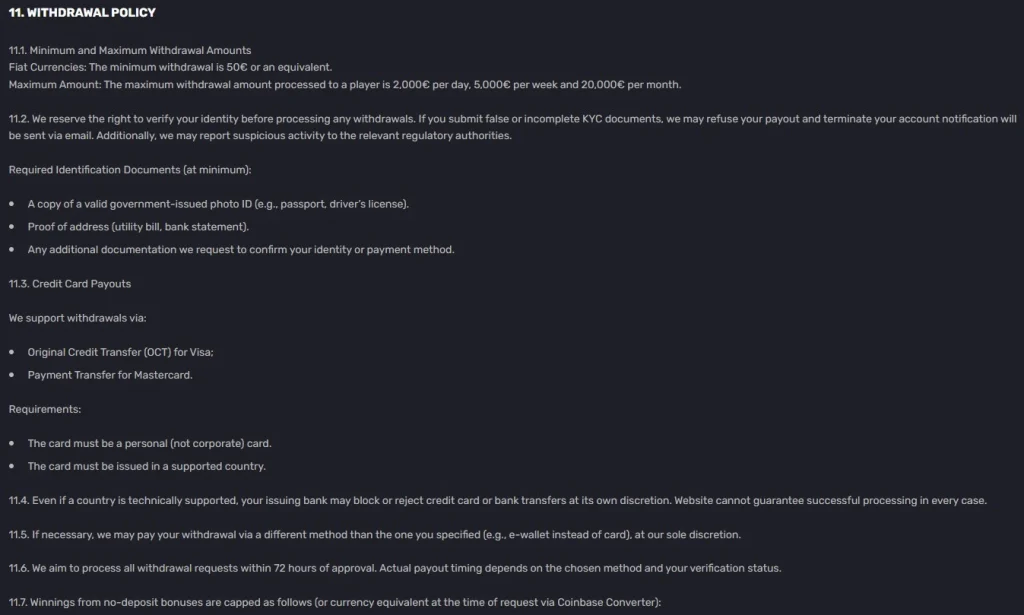
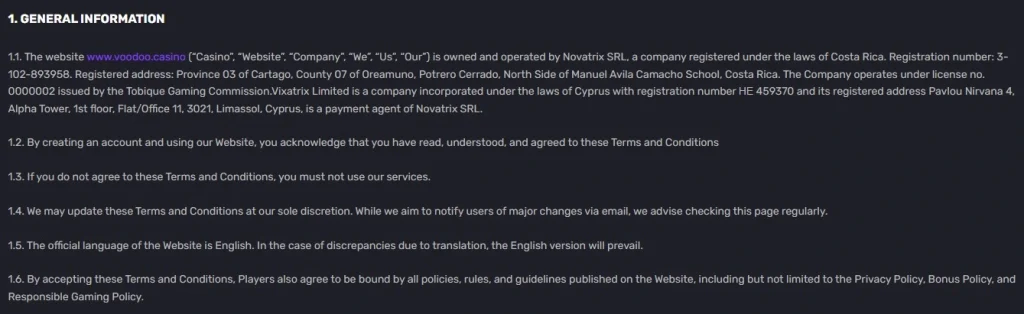
Voodoo Casino publishes a named operator, Novatrix SRL, and its current official terms state that the business operates under Tobique Gaming Commission e-gaming licence No. 0000002. It also publishes KYC rules, a complaints route, 24/7 support and account controls including deposit limits, loss limits and self-exclusion. Those are useful trust signals, but they are not the same as Great Britain regulatory protection.
For a UK reader, the main distinction is local licensing. The Gambling Commission says any business providing remote gambling to consumers in Great Britain needs a Commission licence. Voodoo’s current terms separately list the United Kingdom among countries prohibited from real-money play. That restriction matters more than a generic “safe” label: the brand has identifiable operational controls, while UK-specific access and UKGC protection should not be assumed. The exact UKGC-status check is kept on the dedicated licence page.
Evidence stack
Trust is a set of checks, not a single score
Online casino trust is often reduced to a rating or a yes-no verdict. That shortcut hides the questions that actually matter. A reader needs to know who operates the site, which regulator is named, what identity checks are used, how complaints are handled, what support exists and which responsible-gambling controls are available. Local market status is a separate check again.
| Trust signal | What can be verified | What it does not prove |
|---|---|---|
| Operator identity | Novatrix SRL is named in current Voodoo terms | It does not establish a Great Britain operating licence |
| Published licence | Tobique e-gaming licence No. 0000002 is stated in the official terms | It is not a UKGC licence |
| KYC process | Voodoo states that identity verification may be required before withdrawals | It does not mean UKGC verification rules apply to Voodoo |
| Player controls | Deposit, loss, wager, cooling-off and self-exclusion tools are described on the responsible-gaming page | They should not be treated as proof of GAMSTOP participation |
| Support and complaints | 24/7 support and an internal complaint path are published | This does not establish access to a UKGC-approved ADR scheme |
This framework is more useful than asking whether an offshore or non-local licence is “good” in the abstract. The meaningful question is which protections apply to your account and which authority, if any, supervises the operator for your location. The Voodoo Casino licence goes deeper into that jurisdiction question.
Operator transparency
Novatrix SRL is clearly named in the current terms
Voodoo’s current terms identify Novatrix SRL as the owner and operator and give Costa Rican company-registration details. They also identify Vixatrix Limited in Cyprus as a payment agent. Publishing a specific legal operator is materially better than leaving readers with only a brand name, because it gives a concrete entity to compare across terms, payment wording and licence records.
The same terms say Novatrix SRL operates under Tobique Gaming Commission e-gaming licence No. 0000002. That is a specific licence claim rather than vague wording such as “licensed internationally”. It is appropriate to state that licence as Voodoo’s published regulatory basis, while still keeping it separate from UK licensing.
Independent sources also associate Novatrix SRL with an Anjouan licence, but the stronger evidence for this page is the operator’s own current terms for the exact Tobique number. A second jurisdiction can add context, yet it does not answer the Great Britain question.
Great Britain
The UKGC question changes the meaning of every other trust signal
The UK Gambling Commission states that a business needs its licence if it provides remote gambling facilities to consumers in Great Britain, even when the business is based overseas. That means a Tobique licence and a UKGC licence answer different regulatory questions. One cannot be substituted for the other.
The exact UKGC register-status result is maintained on the dedicated licence page. On this broader trust page, the practical rule is narrower: do not attribute UKGC supervision, UKGC complaint protections or GB-licensed status to Voodoo without direct evidence.
There is a second issue. Voodoo’s official terms, last updated 10 August 2026, currently include the United Kingdom in the restricted-country list for real-money play. That restriction means readers should treat account acceptance as something that requires direct current confirmation rather than inference from a public English-language website or a third-party review.
This is why a blanket “legal” or “illegal” label is not useful here. The better approach is to distinguish the verified Tobique licence, the separate UKGC-status question, the operator’s own UK restriction text and the separate statutory rule that businesses serving Great Britain need a Commission licence.
Verification
KYC is published, but UKGC identity rules should not be projected onto Voodoo
Voodoo’s terms state that KYC may include government-issued photo identification, proof of address and proof of a payment method, and that withdrawals can remain pending until required checks are completed. Those are operator rules published by Voodoo itself. They are relevant to account security and withdrawal readiness.
UKGC-licensed remote operators have their own identity-verification obligations. For Great Britain, the Commission requires core identity details to be verified before a customer is allowed to gamble. That local rule is important as a benchmark, but it should not be described as Voodoo’s procedure unless a UKGC licence and corresponding UK operation are verified.
The practical lesson is to separate two questions. First, does Voodoo publish a KYC process? Yes. Second, does that process place a Voodoo account inside the UKGC framework? The available evidence does not establish that. If you are evaluating registration or verification steps specifically, the Voodoo Casino registration keeps those operational checks separate from licensing.
Player controls
Voodoo provides internal limits and self-exclusion tools
Voodoo’s responsible-gaming page describes several account-level controls. These include deposit limits, loss limits, wager limits, cooling-off periods, session limits and self-exclusion. The page says lower limits take effect immediately, while increases are delayed until the previous limit expires and email confirmation is completed. It also provides a route to request self-exclusion through support.
These are meaningful controls because they let a player put friction around spending, losses or time. They are best used proactively rather than after gambling has already become difficult to manage. A deposit limit can cap incoming funds, while a loss limit or session limit addresses a different behaviour. No single setting covers every risk.
However, internal self-exclusion is not the same as GAMSTOP. GAMSTOP says its online service blocks access to gambling websites and apps licensed in Great Britain, and all online companies licensed in Great Britain must participate. This guide does not claim that a Voodoo account is covered by GAMSTOP without direct evidence of the required Great Britain licensing status. That distinction is central for UK readers who rely on multi-operator self-exclusion rather than one-site controls.
Support and disputes
24/7 support exists, but the escalation route is not a UKGC route
Voodoo’s support page advertises 24/7 assistance and an email channel. Its terms also describe an internal complaint process and say unresolved matters may be escalated to EGIS, an ADR body described there as operating under Tobique Gaming Commission regulations. That is a concrete dispute path, but it belongs to Voodoo’s published offshore regulatory setup.
Do not confuse that route with UKGC-approved alternative dispute resolution for a GB-licensed operator. This guide does not attribute UKGC ADR coverage to Voodoo without direct evidence of the required Great Britain licensing status. The difference matters because “has a complaints process” and “falls within a particular local dispute scheme” are not interchangeable statements.
When assessing a complaint, preserve evidence before contacting support: transaction references, timestamps, account messages and copies of the terms that applied at the time are more useful than a general description of the problem. For broader user-feedback patterns, see the separate Voodoo Casino reputation; anecdotal complaints are not used here to replace verified operational facts.
Money flow
Trust checks should follow the transaction, not just the homepage
A polished lobby says little about how money moves. Before depositing, compare the account name, payment method, verification status and published withdrawal rules. Voodoo’s terms specify that payment accounts should be in the player’s own name and that identity checks may be required before withdrawals. Those controls can reduce some fraud risks, but they also mean incomplete verification can delay access to funds.
The Voodoo Casino payments separates global cashier information from UK-specific availability. That separation is important here because Voodoo’s public terms include currencies and payment methods that should not be read as a promise that the same cashier configuration is available to a Great Britain account.
For trust purposes, the useful test is consistency: legal pages, support answers, cashier screens and withdrawal requirements should tell the same story. If they do not, stop and resolve the discrepancy before adding more money.
Decision checklist
The trust checks that matter most for Voodoo Casino in the UK
Voodoo gives readers several concrete signals to inspect: a named operator, a specific Tobique licence number, published KYC rules, 24/7 support, a complaints process and internal safer-gambling controls. Those facts are stronger than anonymous ownership or vague licence language.
The limiting factor is the Great Britain layer. Voodoo’s current own terms list the United Kingdom as restricted for real-money play. UKGC regulation and GAMSTOP coverage must not be assumed; the dedicated licence page contains the current UKGC-status check. Voodoo does publish internal deposit, loss, wager and session limits, cooling-off options and self-exclusion, while its terms describe an internal complaint route with escalation to EGIS under the Tobique framework. The responsible-gaming page also says lower limits take effect immediately, while increases are delayed. Those are concrete brand-level controls, but they are not substitutes for Great Britain regulatory coverage. For a UK reader, the sensible sequence is to verify local account acceptance first, then check the exact licence and dispute route, then assess payments and account controls. The Voodoo Casino UK review ties those checks back to the wider product without collapsing them into a single trust score.
This material was created by the Voodoo Casino UK Guide team.
Related posts

Voodoo Casino Reputation and Complaints: What the Evidence Shows
Voodoo Casino Licence and UKGC Status Explained